Category: Blog

  • Photographs, Essays, and Fear

    Photographs, Essays, and Fear

    I think that I want to talk about fear today.

    I’ve been trying to write more, and share photographs, and every time I do, I feel a twinge of terror that whatever I’m going to write1 is terrible. I think that what I’m writing right now is terrible. My heart rate is through the roof, and I try to find any and all reasons to not write.

    "My fingers hurt."
    "My keyboard doesn’t work very well."
    "I have no idea what to write."
    "I’m a slow typist."

    And on and on. I feel this all the time. And it’s a problem because I want to write. I want to write a lot. I want to write essays. I want to tell stories. I want to make movies. But this fear – of speaking up, of being heard, of failing, – just won’t go away. And in the end, I don’t know if it matters.

    It’s the fear that keeps me collecting. Keeps me from focusing long enough to put down what I want to say2.

    None of this is good when I’m trying to write posts here, write short stories, or write accompanying blurbs with photos. Not to mention helping Vaidehi with her writing and marketing, and working on building a presence for UAKC. It’s all a lot.

    Anyway. I’m scared every time I sit down to write something. And I think that the only way to make the fear go away is just to do it more.


    1. I’m trying to write something to go along with every photo that I put out, and have a photo accompany every piece of writing.  

    2. Or dictate. I’ve been practicing dictation with the new iOS 15 update. It’s weird to hear myself speak out loud, but it’s getting better. The worst part seems to be holding a train of thought without giving into the urge to correct errors.  

  • What’s in a Name

    What’s in a Name

    "What’s in a name? That which we call a rose
    By any other name would smell as sweet;"

    William Shakespeare, Romeo and Juliet

    I’m sure that Juliet’s rose didn’t have to deal with government documents and social media services. 1

    I want to say that I’ve been thinking a lot about names lately, but the truth is that it’s been on my mind for years. Ever since some overzealous government official decided that I had to have a middle name on my passport, ignoring the fact that my birth certificate doesn’t have one. How much grief has that caused me? And why is it so easy for someone to fuck up my name like that, but so difficult for me to correct that fuckup? I think back to when I went to boarding school and the sign painter spelled my name wrong on my trunk. It led to a nickname that hurt me, but also has stuck with me since the first week of boarding school, and is an indelible part of my identity now.2

    My wife also suffers from this. Her name is spelled differently depending on where in the country she is. Karnataka decided to split her last name because everyone must have an initial at the end of their name and no one (more likely, the software designers) could imagine that a name could be different. Her community doesn’t really do last names though. Your last name is just your father’s name appended to your name. Your official name, that is. There’s a religious name too. 3

    I’ve been thinking a lot about names and their power lately. A lot of this has been related to the CAA-NRC “debate” that went on last year. I use quotes because it doesn’t really feel like a debate. The government is insisting that there is nothing untoward in their bill that specifically excludes members of a particular religion, while the protestors largely disagree. There isn’t much in the way of criticism from the 4th estate, because no one wants to lose access to the government.

    But let’s think about names, shall we? A Muslim friend of ours has a situation where his father’s name is spelled one way on his father’s documents, and another on his. His own name is spelled differently depending on whether it was written directly in English, or transliterated from Marathi. For a simple example of this difference, Krishnan is spelled Krushnan when written in Marathi. Now, this might not be a big deal within Maharashtra. Now imagine that you go somewhere else, somewhere where they don’t understand that this variance in your name is within tolerances. What then?

    Imagine, if you will, that someone is looking to disenfranchise you. Maybe not actively. Maybe they’re being told that it’s important to the security of the country. Maybe they’re just following orders. Or maybe they just don’t want to rock the boat and provide for their family. Upton Sinclair once said, “it is difficult to get a man to understand something when his salary depends on his not understanding it.”45

    I’ve been thinking off and on about this topic since reading patio11’s essay on names. Go read it and think about anything else that you might take for granted about that how the world works.


    1. Besides, look how their names turned out for Romeo and Juliet… 

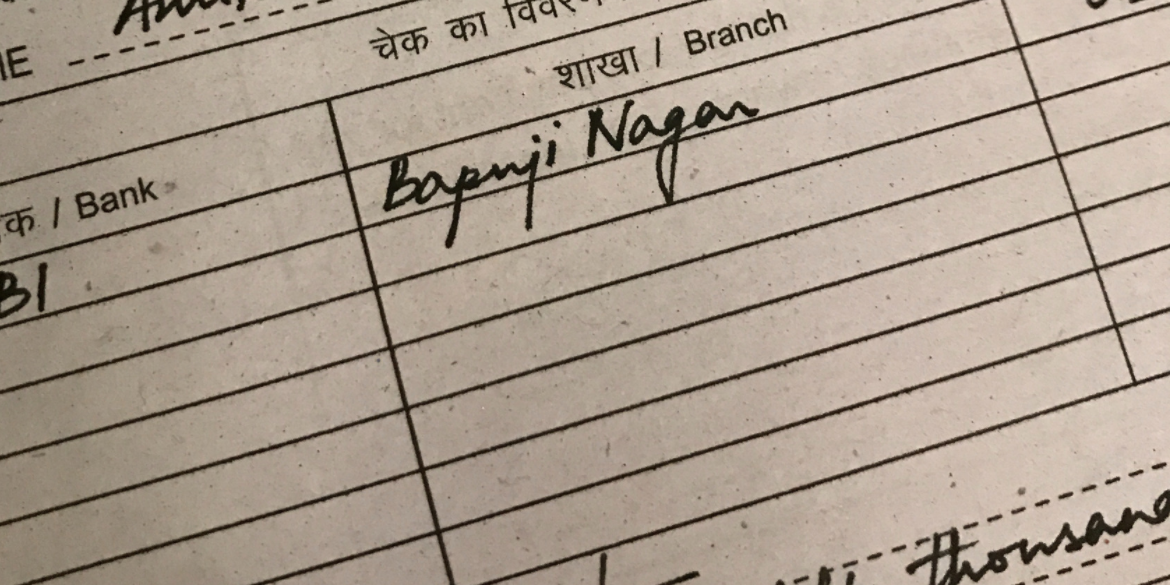
    2. Another example that Vaidehi likes to tell me is where her batchmate was known as Bapuji. That wasn’t his name. He was born on October 2, and when he was being admitted into school for the first time, the teacher thought it would be cute and wrote Bapuji on the form instead of his name. And so, he was stuck with Bapuji (seriously, who calls a 4 year old that?) until the moment he could legally change his name as an adult.  

    3. I didn’t know our community even had one. Discovered that during the wedding when there was a puja where we rename the woman once she enters her new home. My wife is attached to her religious name (she’s named after her grandmother). Eventually, we found a compromise, and she calls me her knight in clever armour. I’ve since learned that there are several communities that change a woman’s full name when she gets married. 

    4. There’s probably an interesting case to be made for modding Papers Please to a context where you are someone in charge of enforcing such laws. 

    5. Facebook has a real name requirement, and it’s not without controversy. And look, they don’t recognise Tamil naming conventions. These days, if you’re not on Facebook, you’re cut off from many communities and services. Now imagine that they don’t recognise your name. It would be like you don’t exist, and they don’t really care, because you don’t fit their naming conventions.naming conventions around the worldnaming conventions around the world 

  • Commemorative Coinage

    Commemorative Coinage

    Ever since demonetisation and the introduction of new notes in India, I’ve been thinking about how that was a missed opportunity to celebrate the country. Sure, the new notes do hype our space programme, and different monuments, but it’s Mahatma Gandhi on every note. That’s to be expected – the notes are part of the Mahatma Gandhi series1.
    What I’ve been thinking about was a new series that resembles the commemorative quarters programme in the US. For about a decade, the US Mint released 4 or 5 special edition ¢25 coins that celebrated a state each. Starting in 2022, the American Women Quarters programme will put out a collectible series for four years that celebrates notable women in America. 2
    They have different figures from their history on their notes.3 While ours resembles the British system where a single person (Mahatma Gandhi for us, and Queen Elizabeth II for the British) is represented on the notes.
    What would a commemorative currency programme look like in India? We have 28 states and 8 UTs. We have coins for ₹1, ₹2, ₹5, ₹10, and soon, ₹20, and notes for the denominations of ₹5, ₹10, ₹20, ₹50, ₹100, ₹200, ₹500, and ₹2000 rupees. That’s a lot of opportunities to celebrate important people, places, languages, and events from around the country. To celebrate the diversity of the country.
    There have been commemorative coins issued by the Mints to celebrate individuals or big government policies or major events that the country has hosted.
    Most people might ignore it, but I would bet that there are many of us who would love to see our regions highlighted to the rest of the country. Personally, I grew up outside my home state, and learned very little about it as a result. I would love to have seen it acknowledged on something that we use as frequently as money.
    Oh, and if you find the Biju Patnaik coins from 2015? Send me a picture!


    1. This is the new Mahatma Gandhi Series. So far, we’ve had the Lion series and two Mahatma Gandhi series of notes – original and new. 

    2. The US Mint announced the first two honourees for the Women’s Quarters programme. 

    3. Notes take longer to design than coins because of all the anti-counterfeiting measures that are required to be implemented. Harriet Tubman was announced to be the new face of the $20 note in 2016, but it’s unlikely that the new note would see circulation until at least 2030 coinagecommemorative coinagecommemorative coinagecommemorative coinagecommemorative coinage 

  • A Jigsaw Puzzle: Distribution Options for Indie Films

    A Jigsaw Puzzle: Distribution Options for Indie Films

    As the pandemic stretches on, I’ve noticed friends and family seek out lighter fare on TV and streaming platforms. Friends, How I Met Your Mother, and the like.1 They’re bouncing off prestige2 shows faster than ever. No one wants to see hard narratives. Life is hard enough, and what people are looking for is escapism.

    I briefly mentioned in a previous post that every film faced distribution challenges during the pandemic. Everyone is trying to figure out how to make movies during the lockdown, and then, sell the movies to make enough money so that you can make the next one.

    In an article for Moneycontrol, Indian producers talk about how difficult the lockdown restrictions, even when they are eased, have made productions. Working hours are shorter (night shoots are next to impossible), and all the work needs to be done in a bio-bubble. Everyone working on the film needs to be paid their regular wages, no doubt about that, but it does mean that schedules will run longer if working days are shorter. Night shoots are practically impossible. Bio-bubbles being enforced mean that producers have to bear the cost of accommodation as well.3

    Denis Villeneuve has cast doubt on his Dune duology being completed if WB releases the first part directly to HBO Max. Emily Blunt mentioned in an interview that it’s unlikely that the sequel to Edge of Tomorrow would happen because the budget for a film like that would be too large. It would be unlikely to make its money back.

    Guaranteed blockbusters like Suryavanshi are being held back until theatres reopen. Others are heading straight to streaming services. WB and Disney are experimenting with different release strategies. Tenet was a theatrical release, while Mulan was released to Disney+ with for an additional fee before going free to all subscribers a few months later.

    Right now, Scarlett Johansson and Disney are in a legal suit based on how the release strategy for Black Widow has affected her compensation. Black Widow may have set box office records during the pandemic, but it’s looking to be one of the lowest grossing films in the Marvel Cinematic Universe.

    Streamed films do not generate box office returns and a lot of compensation and production budgets are dependent on them.

    So where does that leave indies?

    This was one of the major points being discussed during Marché du Film. How does independent film survive in an environment where audiences are seeking out comfort fare? Where theatrical releases are not always an option and digital distribution does not favour immediate returns?

    There are a few options available:

    • Waiting to release the film when theatres reopen,
    • Releasing it to streaming services, or
    • Self release and distribution.

    Waiting to release is an option that requires a lot of faith and a lot of money. Not that you have to have a lot of money, but that you have to be okay with having the money tied up with the film until you can release it to theatres. And you limit your options for new projects that you might not have the capital for. I’ll be honest – waiting that long is a terrifying prospect. You’re waiting for theatres to open, for audiences to be ready to tackle challenging cinema, and finally, hoping that the film you’ve created hasn’t missed its moment.

    Streaming services are the option that everyone suggests. Why don’t you release your film on Amazon Prime or Netflix, they ask. What they imagine is selling a film to a streaming platform for a large sum of money. The reality for a lot of indies is far more like putting your film up on YouTube and hoping that someone will watch it.

    Those are not the only options, of course. There are dedicated platforms for any kind of cinema that you can think of. The biggest name in Arthouse Cinema streaming is MUBI, and they run a very tightly curated selection of films.

    But getting a film onto a streaming service is not the easiest option, and brings an ever-present risk of piracy with it. A filmmaker I recently spoke with said that it didn’t matter that his film was available for ₹30 on a streaming platform or on YouTube. People were instead watching it on Telegram channels that were sharing a ripped version of the film.

    And you still have to market your film to any potential viewers – viewers who are spoiled for choice and currently seeking out comfortable content.4

    Speaking of doing your own marketing, there’s the third option: self release and pay-per-view distribution. This is a slow process – because this is where you have to do all the work. Like in the previous option, you have to cast a wide net, getting the attention of viewers around the world who might watch the film, then give them a way to easily watch it, and finally, figure out how to make them pay for the film. It can be a long, slow process.

    I’ve seen filmmakers do this. The one that sticks out in my mind is how Sandeep Mohan got his film Hola Venky in front of audiences. I watched the film at a co-working space where he projected the film from his laptop onto a wall and used the venue’s speakers for sound. At the end, he hosted a Q&A and asked that we contribute what we felt comfortable contributing.

    No matter which option you take, it’s nerve-wracking. It’s also really exciting. It feels like the start of a rollercoaster, where you’re slowly being pulled to the top before going into a dive, or looking at a jigsaw puzzle immediately after you’ve dumped it on a table to start assembling it.
    1. Over in our house, we’re binging Once Upon A Time, Critical Role, and finishing the last season of Madam Secretary

    2. A prestige show is one that’s supposed to be of a higher quality than regular TV. It’s usually a drama and runs on a premium cable channel. Shows like The Sopranos, Breaking Bad, Mad Men, and House of Cards

    3. Malcolm and Marie was filmed last year in a bubble. The first thing that we noticed when we saw how the bubble was maintained was that it would be very expensive for the producers to run a production like that. 

    4. And there’s nothing wrong with that at all. It just makes getting Arthouse films seen harder than it normally is.